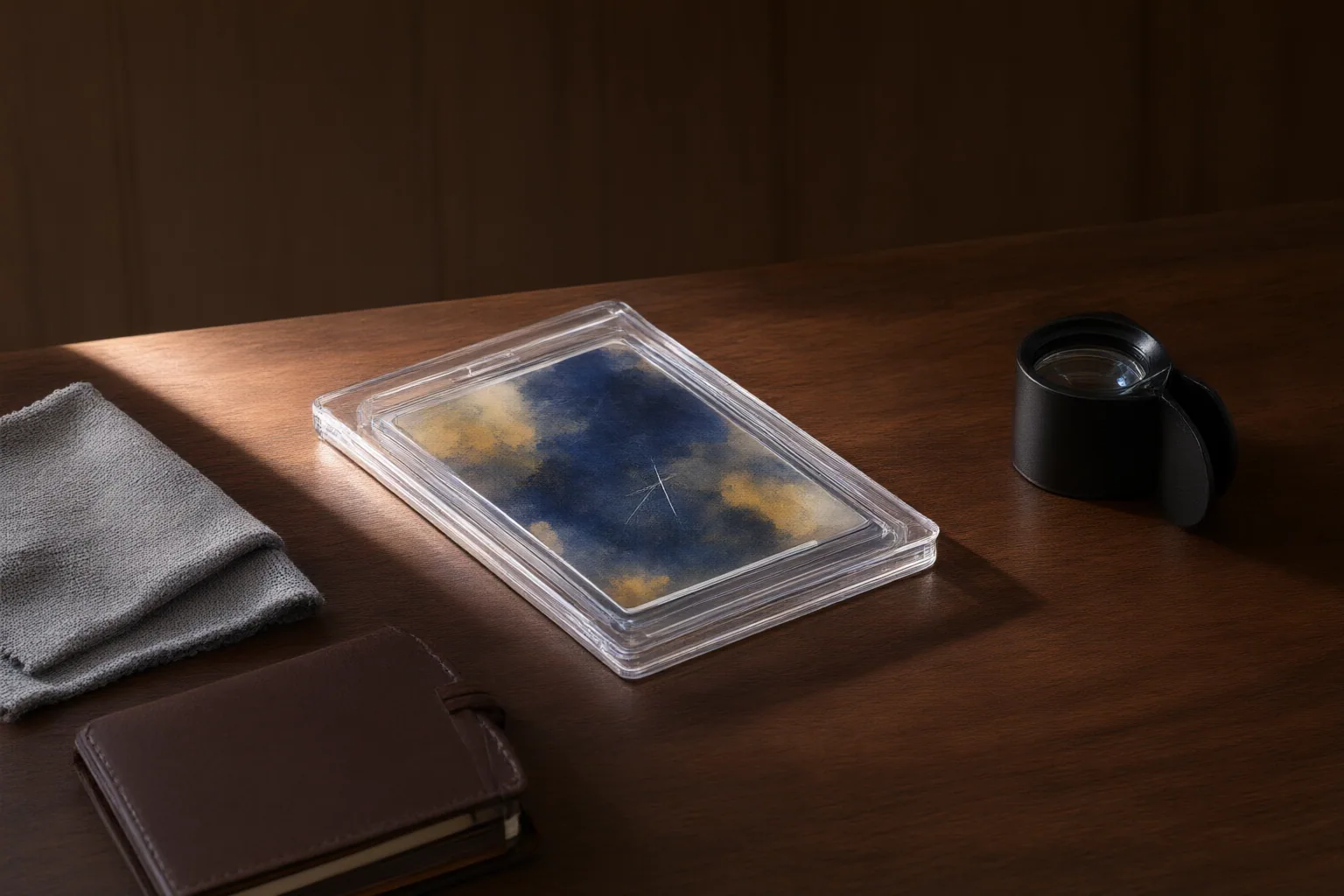
A changing light angle can make a fine scratch easier to see, but it cannot conclusively establish whether a mark is on the card or the sealed holder. Use controlled lighting, rotation and magnification to document what is visible, and leave the location unresolved when the evidence remains ambiguous.
Why a Scratch Can Be Difficult to Locate
Fine scratches may disappear in ordinary lighting and become visible only when they reflect light at a particular angle. Get Graded says micro-scratches reflect differently from the surrounding surface, while CardPreGrading notes that some scratches appear only at certain orientations.
Those principles help explain why a mark can seem to appear and vanish as a graded card is moved. However, the cited inspection guidance concerns examining card surfaces directly. It does not provide a validated test for separating a scratch on the enclosed card from one on the holder. The extra reflective surface of a sealed holder therefore leaves an important limitation: angled light may reveal the mark more clearly without proving which surface carries it.
Treat the first inspection as an observation exercise. The useful questions are when the mark becomes visible, how it reflects and whether its appearance changes with orientation. Those observations can narrow what you see, but they should not be presented as authentication or a definitive location finding.
Use Angled Light and Controlled Rotation
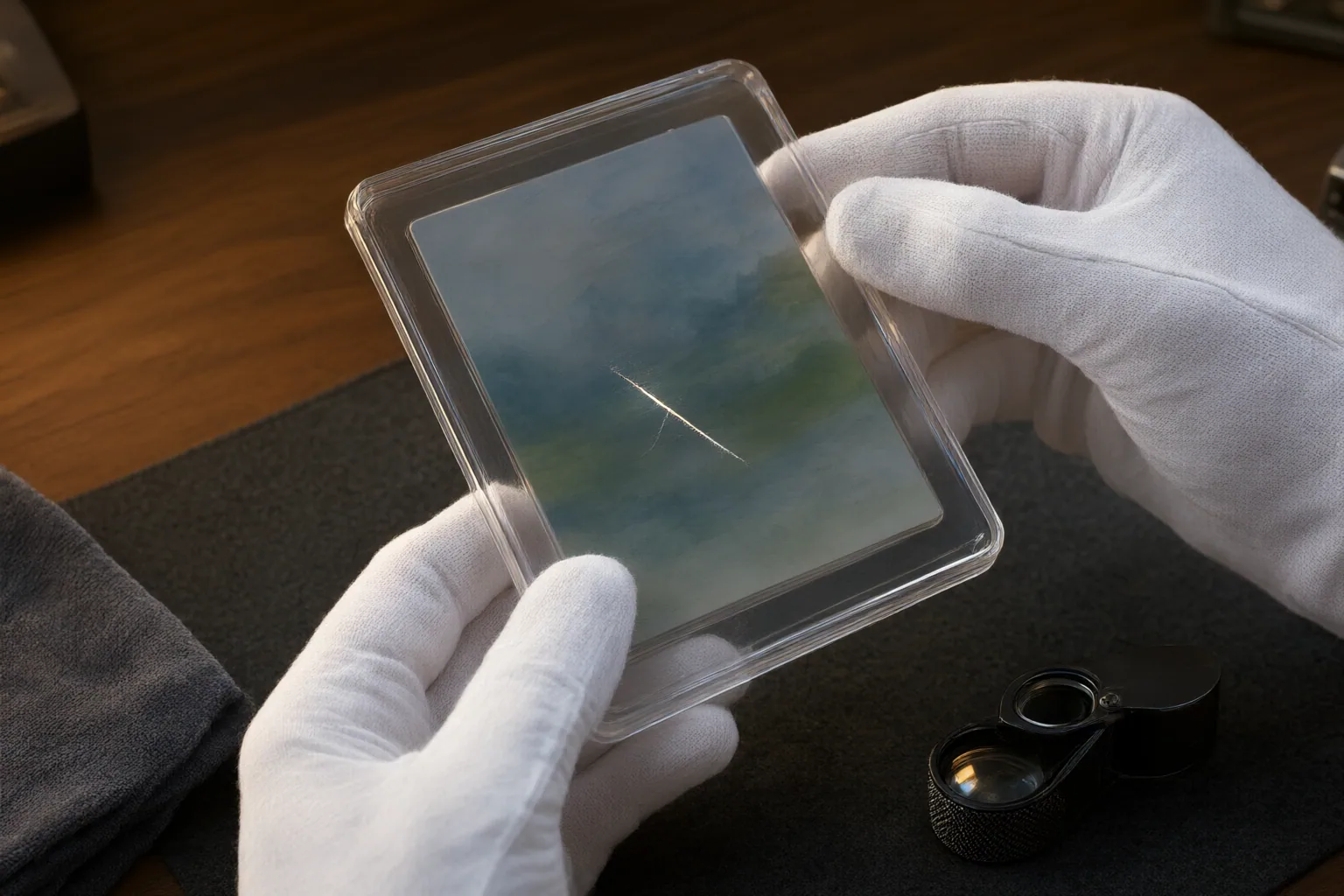
Start with one bright light positioned obliquely rather than relying on general room lighting. CardPreGrading recommends a single oblique light source and slow rotation; Get Graded similarly recommends slowly tilting a card under angled bright light. Move deliberately so you can identify the angle at which the suspected scratch begins to reflect.
Observe the mark through several orientations instead of deciding from one view. Rotate the holder slowly, then repeat the inspection after turning it 90 degrees. CardPreGrading recommends this second orientation because some scratches become visible only at particular angles. Record which positions make the line brighter, fainter or invisible so that you do not rely on memory alone.
This routine can improve visibility, but the result must be interpreted cautiously. A mark that changes under angled light may be a reflective surface feature, yet the supplied sources do not establish that its changing appearance identifies whether it lies on the card or the holder. Do not turn a clearer view into a stronger conclusion than the evidence supports. If repeated rotation still leaves two plausible locations, describe the scratch location as uncertain.
Check for Print Lines and Other Surface Features
A visible line is not automatically a scratch. The Midpoint guide treats scratches and print lines as distinct surface defects, although both may attract attention during reflective-light inspection. That distinction matters when describing what you see: “linear mark” is more accurate than “scratch” until the feature can be identified with adequate confidence.
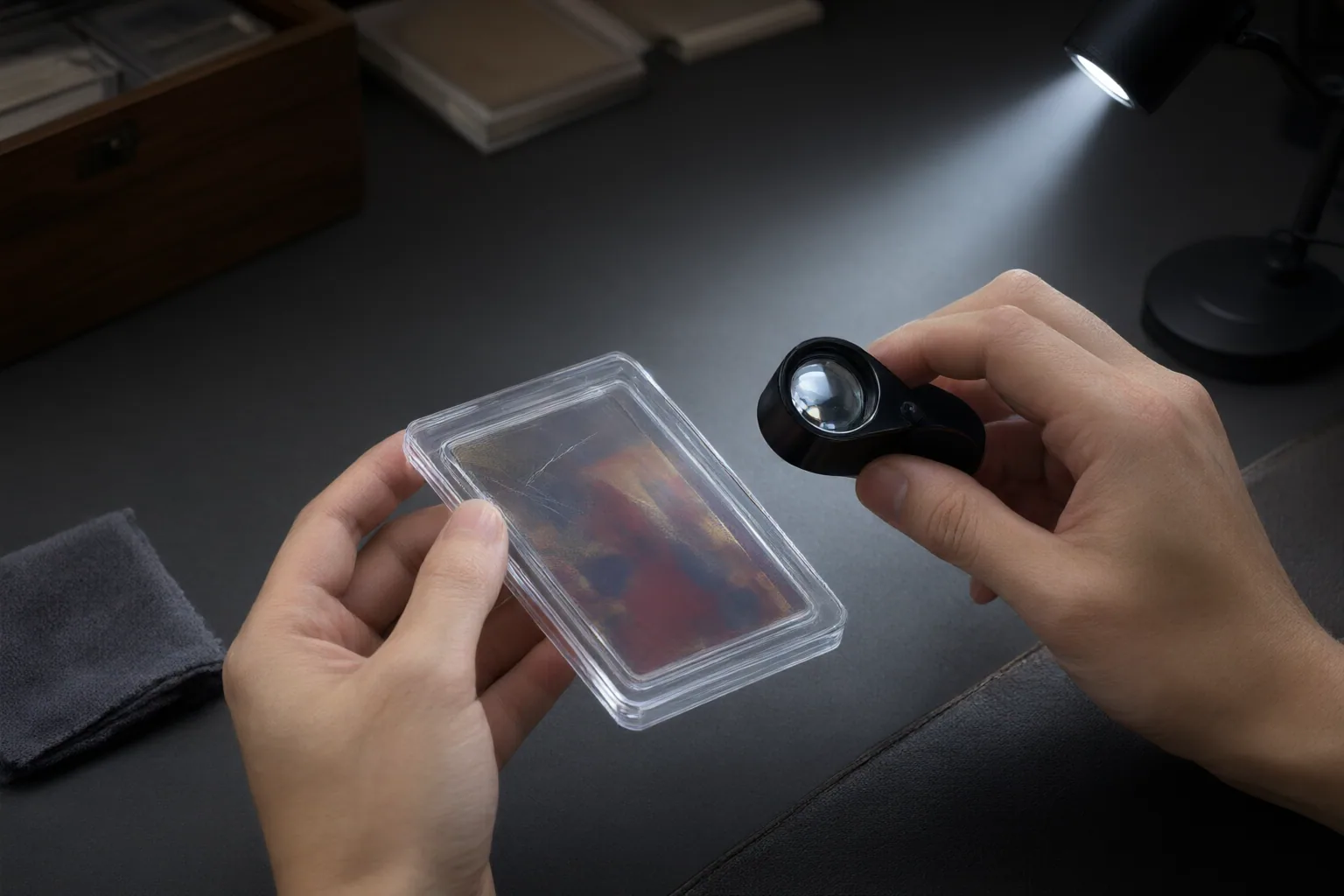
Use good lighting and magnification for a closer look, as recommended by the Midpoint guide. Repeat the same slow-angle inspection rather than changing several conditions at once. Look for a consistent outline and note how the feature responds when the orientation changes. These observations may help characterize the line, but they do not create a validated card-versus-holder test.
Magnification can make a small feature easier to observe without resolving its depth or location through sealed plastic. If the evidence remains ambiguous, retain neutral wording in collection records and avoid treating the mark as confirmed card damage or a confirmed holder scratch.
Conclusion
Scratch location can matter when interpreting condition, but a visible line alone does not justify predicting a grade. CGC Cards publishes standards for a 10-point grading scale covering trading cards, sports cards and non-sports cards. Its highest designation, Pristine 10, is described as flawless under 10-times magnification. That context shows why close surface inspection matters, but it does not allow a collector to reproduce a professional grading decision through a holder.
Use the available techniques for what they can support: careful observation. Inspect the holder under one oblique light from several orientations, repeat the check after a 90-degree rotation, and write down what changes. If those observations do not clearly resolve where the mark sits, record the location as uncertain rather than claiming a grade, authentication result or definitive diagnosis.
Disclosures and limitations
- This article was prepared with AI assistance from the supplied CGC grading documentation and non-official card-inspection sources; practical techniques are presented as cautious observations, not a definitive test.
- No products are recommended, and no affiliate relationship is represented in this article.
Related reading
Sources
- Grading Scale | Sports Card Grading | CGC — CGC Cards
- Surface Scratches vs PSA Grade: How They Cap Your Grade (2026) — CardPreGrading
- How to Check a Sports Card for Hidden Flaws – Get Graded — Get Graded
- Holo Scratch and PSA Grades: How Bad Is Too Bad? — Pokemon Pricing
- Card Condition: The Complete Guide to Grading, Inspection, and Value — Midpoint – Card Centering, Grading, Portoflio Manangement Blog