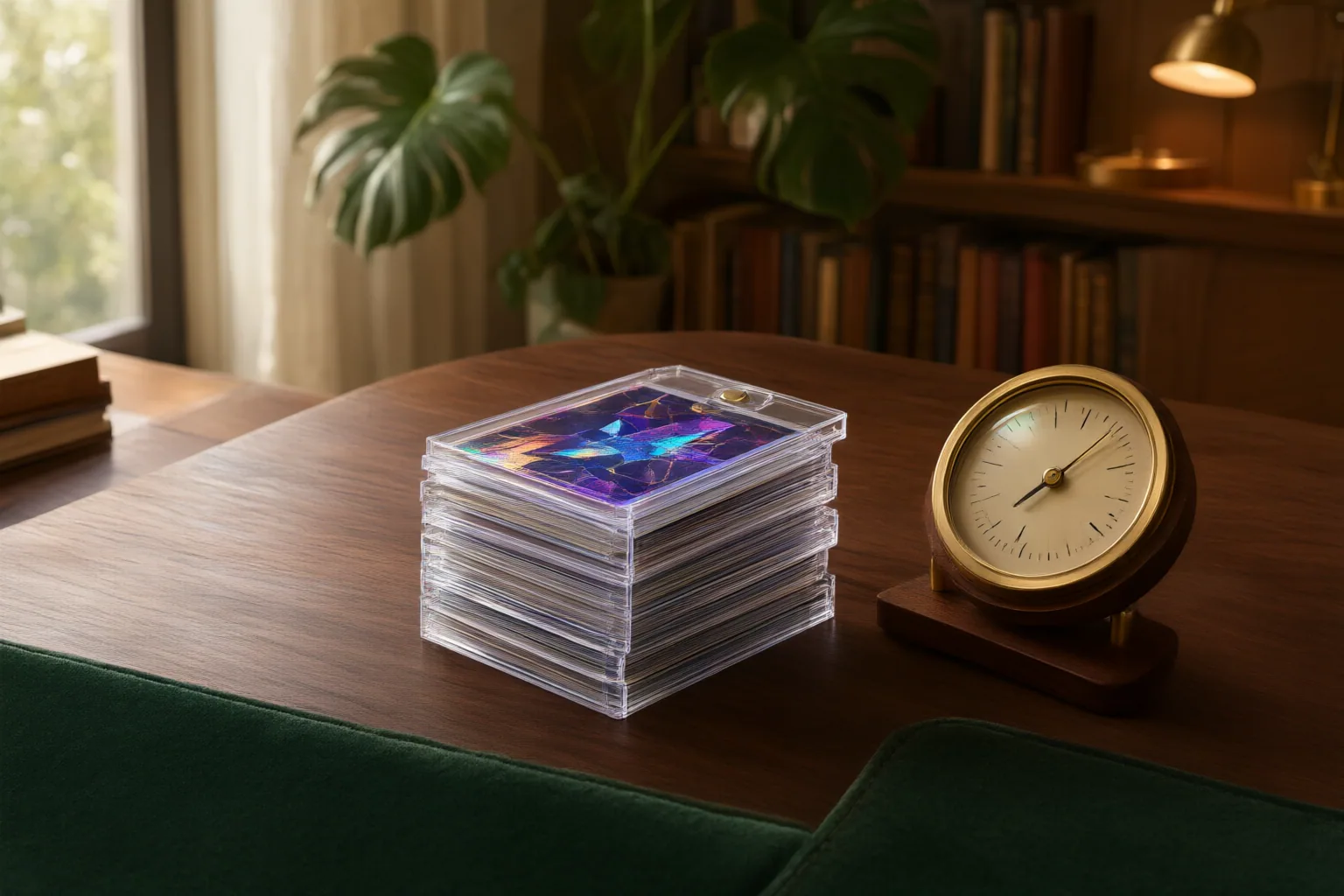
For home trading-card storage, several collector-oriented guides recommend approximately 45–55% relative humidity. Treat that range as practical guidance rather than a scientifically established universal standard, and prioritize measured, stable conditions over reactions to a single reading.
What relative humidity should trading cards be stored at?
A practical target for relative humidity for trading cards is about 45–55%. CardSense AI, What The Slab and Card Fit Lab all recommend approximately this band. Other guidance is less narrow: ProtecVault suggests 40–55%, while The Card Shop Finder cites a broader paper-conservation range of 30–60% and notes that hobby guidance commonly tightens it.
These differences matter. The figures should not be presented as one universally proven cutoff. Card Fit Lab describes 45–55% as a community and conservation-informed consensus, not an optimum established for trading cards through a controlled, peer-reviewed study. In practice, the narrower band provides collectors with a useful home-storage target while leaving room to recognize that published recommendations vary.
A reading just outside 45–55% therefore does not, by itself, establish that damage has occurred. The more useful question is whether the storage environment remains persistently damp, excessively dry or prone to substantial changes. Measuring conditions over time provides more meaningful information than relying on a room’s apparent feel.
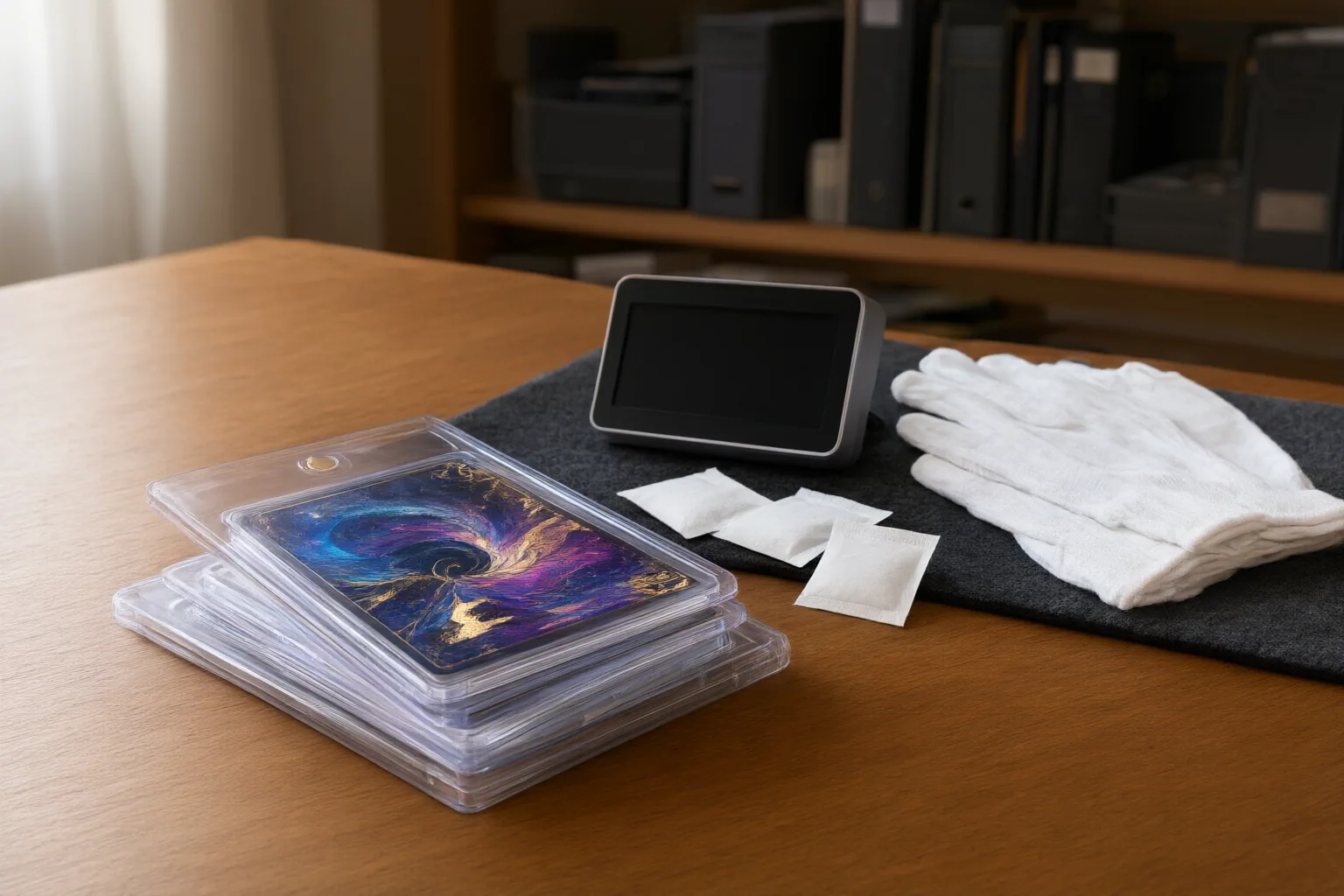
How dampness, dryness and fluctuations affect cards
Humidity presents a two-sided storage problem. Several guides state that, under humid conditions, paper fibers can absorb moisture. This is associated with curling or warping, while persistently damp conditions may also support mold growth. The available sources do not establish one universal humidity threshold at which these effects begin, so the risk is better understood as a reason to avoid sustained excess moisture.
Excessive dryness creates a different concern. Depending on the guide, conditions below roughly 30–40% RH are associated with brittleness, cracking or damage around card edges. Driving humidity as low as possible is therefore not a sensible substitute for controlling dampness.
Large or repeated changes in humidity and temperature are another concern. The cited guides explain that layered card materials may absorb and release moisture, with their components expanding and contracting at different rates. This makes stability important alongside the numerical reading. A storage space that repeatedly moves between dry and humid conditions may be less suitable than an interior location that remains comparatively steady within the commonly recommended range.
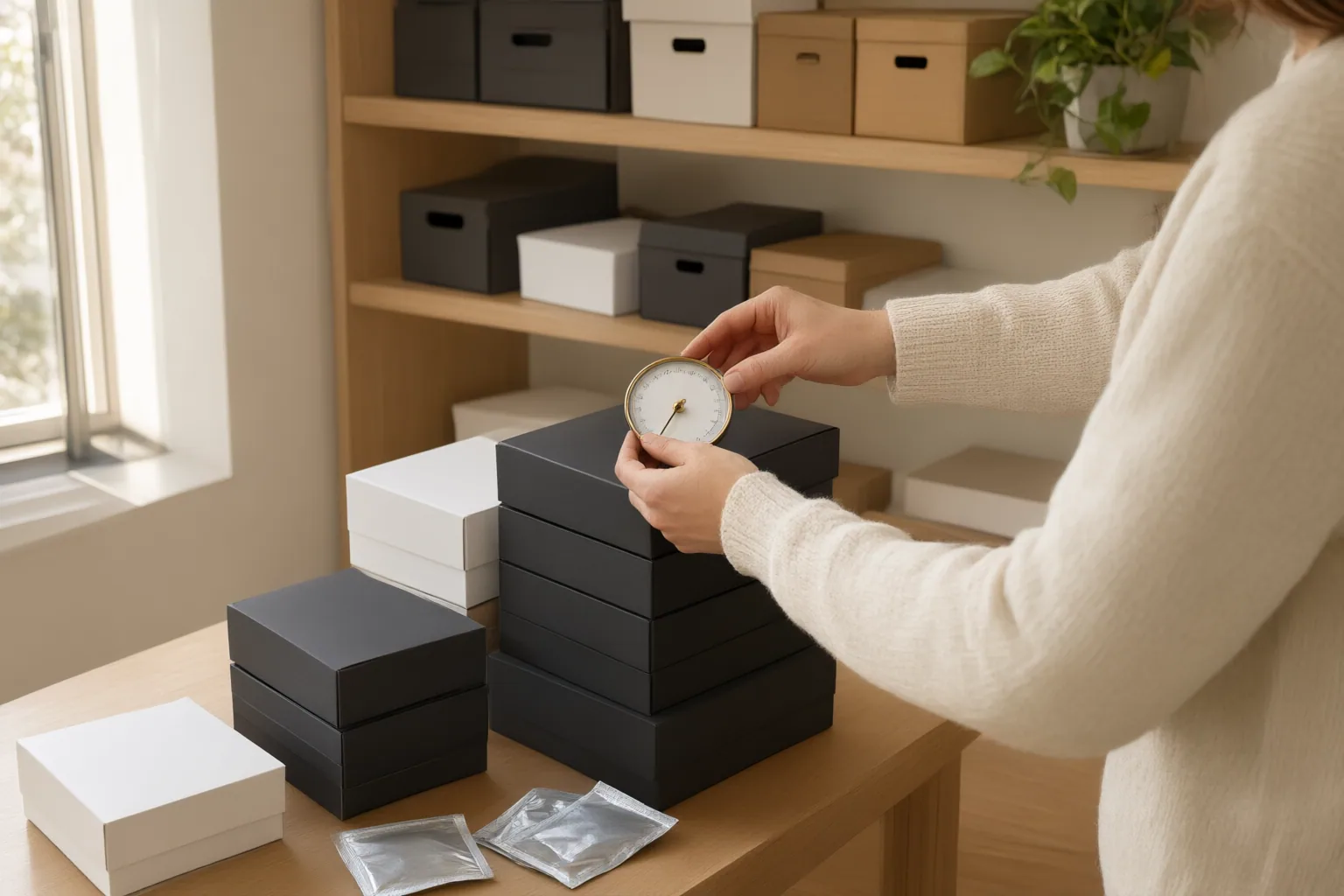
How to measure and manage humidity at home
Start with a hygrometer in the area where the collection is actually stored. Multiple guides recommend measuring relative humidity rather than judging conditions by whether a room feels damp or dry. Record readings over time so that persistent conditions and fluctuations become visible instead of treating one measurement as a complete picture.
Storage location is the next control. The guides repeatedly favor an interior location within the lived-in, climate-controlled part of a home. Attics, garages and basements are commonly discouraged for long-term storage because they can expose cards to humidity or temperature extremes and seasonal changes. If readings remain unsuitable, moving the collection to a more stable interior space may be more effective than trying to manage only the container.
Silica gel can help buffer moisture inside a closed container, but its role is limited. It can become saturated and requires periodic recharging or replacement. Card Fit Lab also cautions that silica gel cannot correct a room that remains persistently damp or otherwise unsuitable. Using an absorber without continued measurement may therefore create false confidence.
A practical routine is to measure the storage area, track whether it stays near the commonly cited range, and assess how much it changes. If it remains damp, very dry or unstable, address the surrounding room or relocate the cards. Container-level moisture buffering can supplement that approach, but it does not replace environmental monitoring.
Conclusion
Approximately 45–55% RH is the most consistent practical recommendation across the cited collector guides, although wider ranges also appear and the narrower target is not a scientifically established universal standard for trading cards. Stable, measured conditions matter more than reacting to an isolated reading. Check the storage area with a hygrometer, record readings over time, and move the collection to a more stable interior location if conditions remain persistently damp, dry or unstable.
Disclosures and limitations
- This article was prepared with AI assistance from the supplied research package and approved content plan; material claims are attributed through the accompanying source IDs.
- The sources are collector-oriented or commercial guides rather than primary conservation research. No products are recommended, and no affiliate relationship or product-performance claim is presented.
Related reading
Sources
- How to Protect Cards from Humidity (Stop Warping and Mold) — CardSense AI
- How Humidity & Temperature Affect Your Trading Cards — ProtecVault
- How to Protect Cards From Humidity (2026 Guide) — What The Slab
- The right humidity and temperature for card storage — cardfitlab.com
- Humidity Control for Trading Card Storage: A Practical Guide | SlabSafe Blog — SlabSafe
- How to Store Trading Cards Long Term: The Real Numbers — The Card Shop Finder