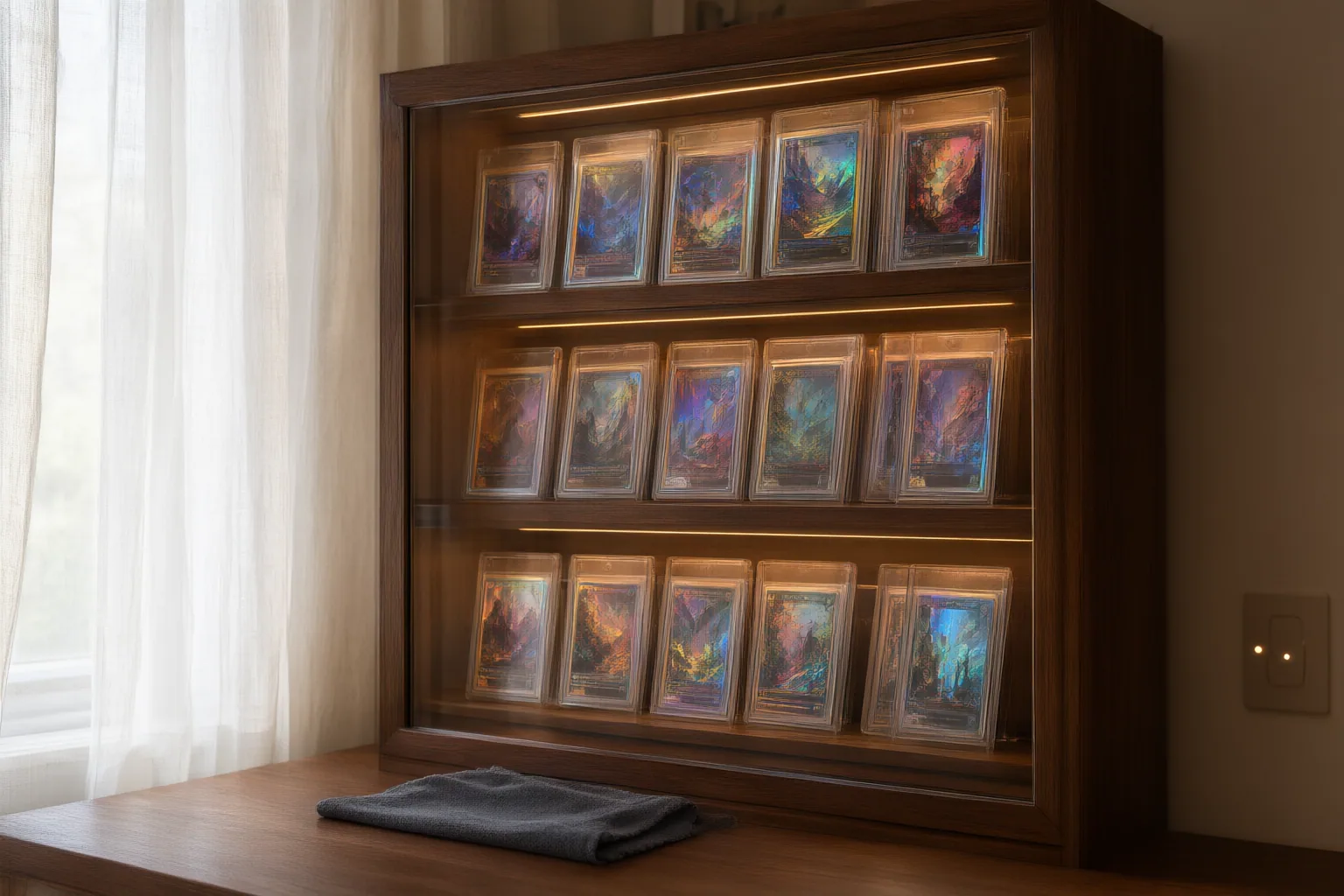
Keep displayed cards away from window daylight, use materials with explicit UV-filtering specifications, choose lower-UV lighting, and rotate cards periodically. These layers can reduce exposure, but they cannot guarantee that fading will never occur.
Why visible cards need protection from cumulative light exposure
UV exposure can degrade printed inks and contribute to fading or yellowing. The supplied collector guides describe this damage as cumulative: small amounts of exposure add up over time. Because the change may develop gradually, a collector might not notice it until the card has visibly altered. The same guides say that this damage cannot be reversed once it has occurred.
Direct sunlight is therefore the first exposure to address, but it is not the only concern. Daylight reaching a display through a window can still present a risk even when sunlight does not appear to fall directly on the card. Moving a display deeper into a room or onto a wall that receives less daylight is a practical starting point.
Displaying a card always calls for risk reduction rather than a promise of complete protection. No evidence in the supplied sources establishes that a particular display arrangement eliminates fading or makes unlimited exposure safe.
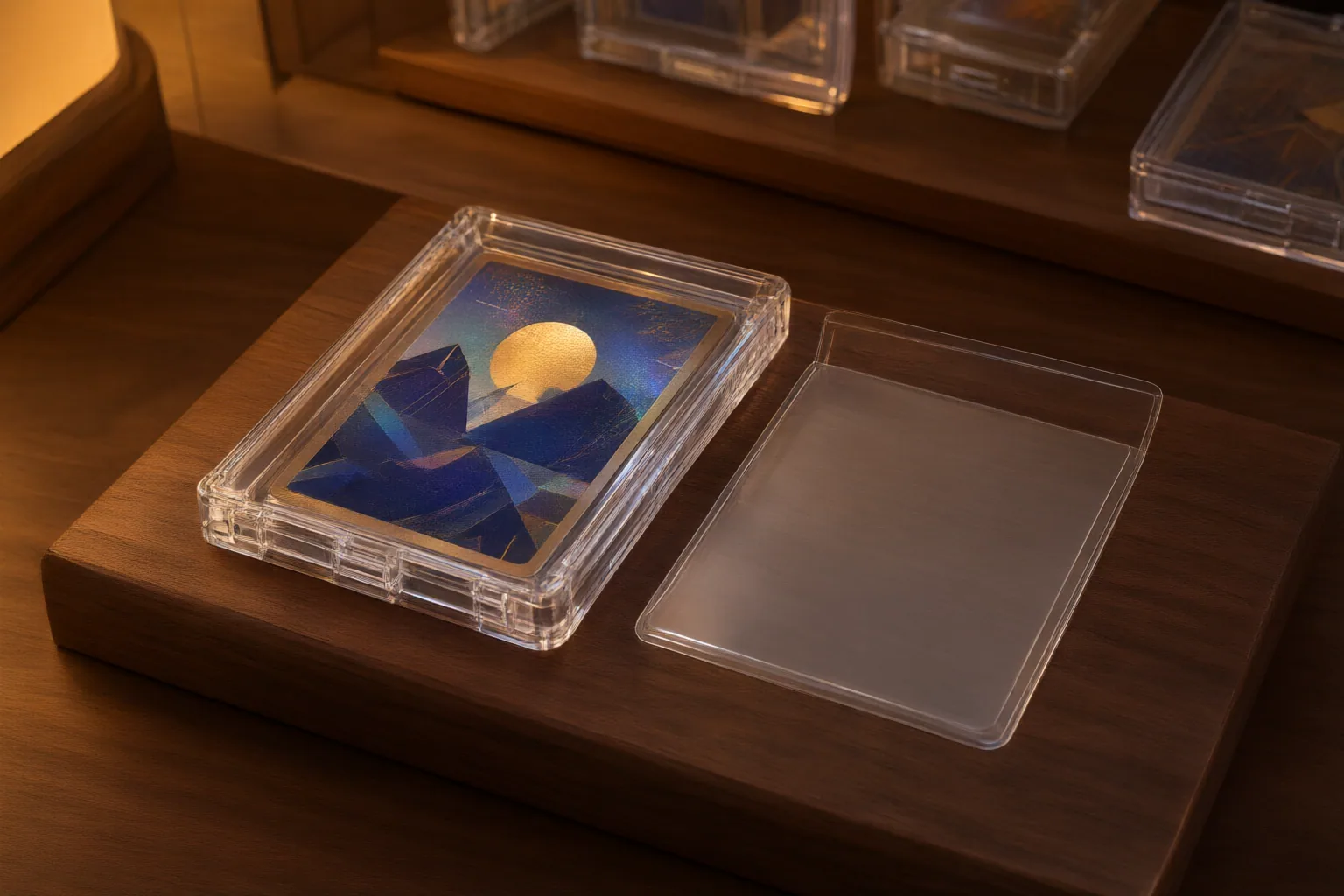
Do not assume a sleeve, toploader, slab, or clear case blocks UV
A holder can protect a card well in one respect while providing no established protection in another. Standard sleeves primarily help guard against dust, fingerprints, and scratches. Rigid holders add support against bending and handling damage. Those functions matter, but they do not by themselves show that the material filters ultraviolet light.
Transparency, thickness, or rigidity should not be treated as evidence of UV protection. A sleeve, toploader, slab, or display case may look substantial without having a stated UV-filtering function. Check the maker or seller’s specification for an explicit UV-protection claim. Where possible, look for a defined protection or transmission figure and the ultraviolet range to which it applies; vague phrases are harder to compare.
Physical protection and light management should therefore be considered separately. A card may still need a suitable sleeve or rigid holder for handling while relying on verified display material, careful placement, and controlled lighting to reduce light exposure.
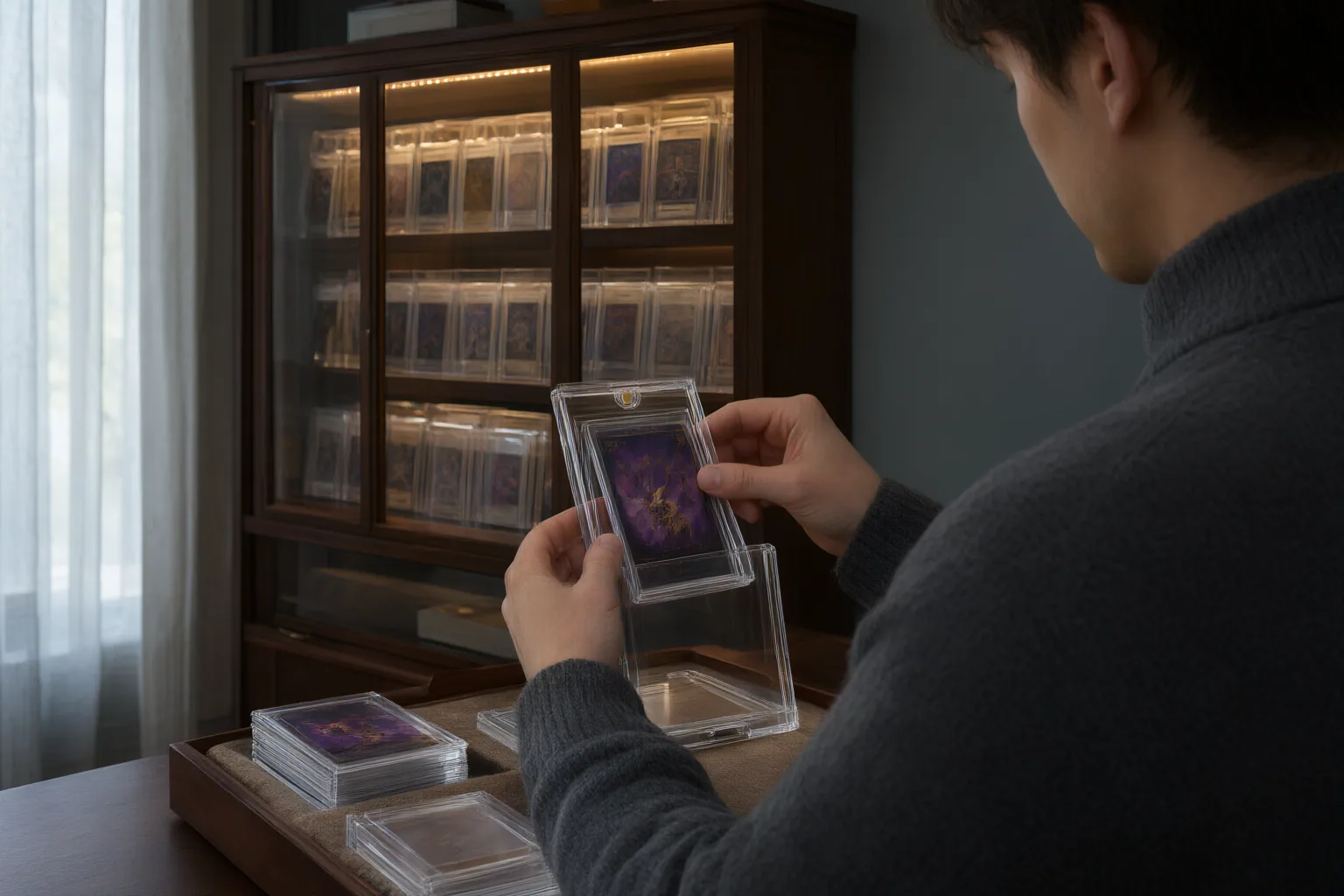
Build a layered display strategy
Start with placement. Keep cards out of direct sunlight and move displays away from windows or other positions receiving substantial daylight. Distance and room layout can reduce exposure before any specialist display material is considered.
Next, use display glazing, cases, or other materials specifically represented as UV-filtering. Confirm what the specification actually says rather than assuming every clear barrier performs this role. The supplied sources are commercial collector guides rather than independent conservation standards, so broad product-performance claims deserve caution.
Review artificial lighting as another part of the display. The guides identify fluorescent and halogen lighting as additional exposure sources and generally present LED lighting as a lower-UV option. This supports choosing lower-UV lighting, but it does not mean that every LED arrangement makes exposure harmless.
Finally, rotate the cards on view. Rotation limits how long any one card remains exposed and lets a collection stay visible without leaving the same items in the display continuously. The sources do not establish a universally safe rotation interval, so avoid treating a fixed number of days or months as guaranteed protection. Base the routine on reducing exposure consistently, especially for displays that receive more ambient light.
Conclusion
Protecting displayed trading cards is a layered task. Reduce daylight first, keep physical protection separate from verified UV filtration, choose lower-UV lighting, and rotate the cards on view. None of these measures guarantees that fading will never occur, but together they address more risks than relying on a clear holder alone.
Audit one display now: move it away from daylight, verify any UV-protection specification, review the lighting, and select which cards will rotate out next.
Disclosures and limitations
- This article was prepared with AI assistance from the supplied research package and approved content plan; material claims are attributed to the listed source IDs.
- The supplied sources are commercial collector guides or blogs, not independent conservation standards. No product records or affiliate recommendations were used.
Related reading
Sources
- UV Protection for Trading Cards: Why It Matters — Cardshellz
- UV Protection for Cards: A Collector's Guide to Preventing Fade — Next Gen Cards LLC
- 10 Best Trading Card Display Cases With UV Protection for 2026 – thegamersmag.com — wordpress-883468-5565050.cloudwaysapps.com
- UV Protection for Trading Cards: Prevent Fading — Phantom Display
- The Complete Guide to Protecting Your Trading Cards — Cardshellz