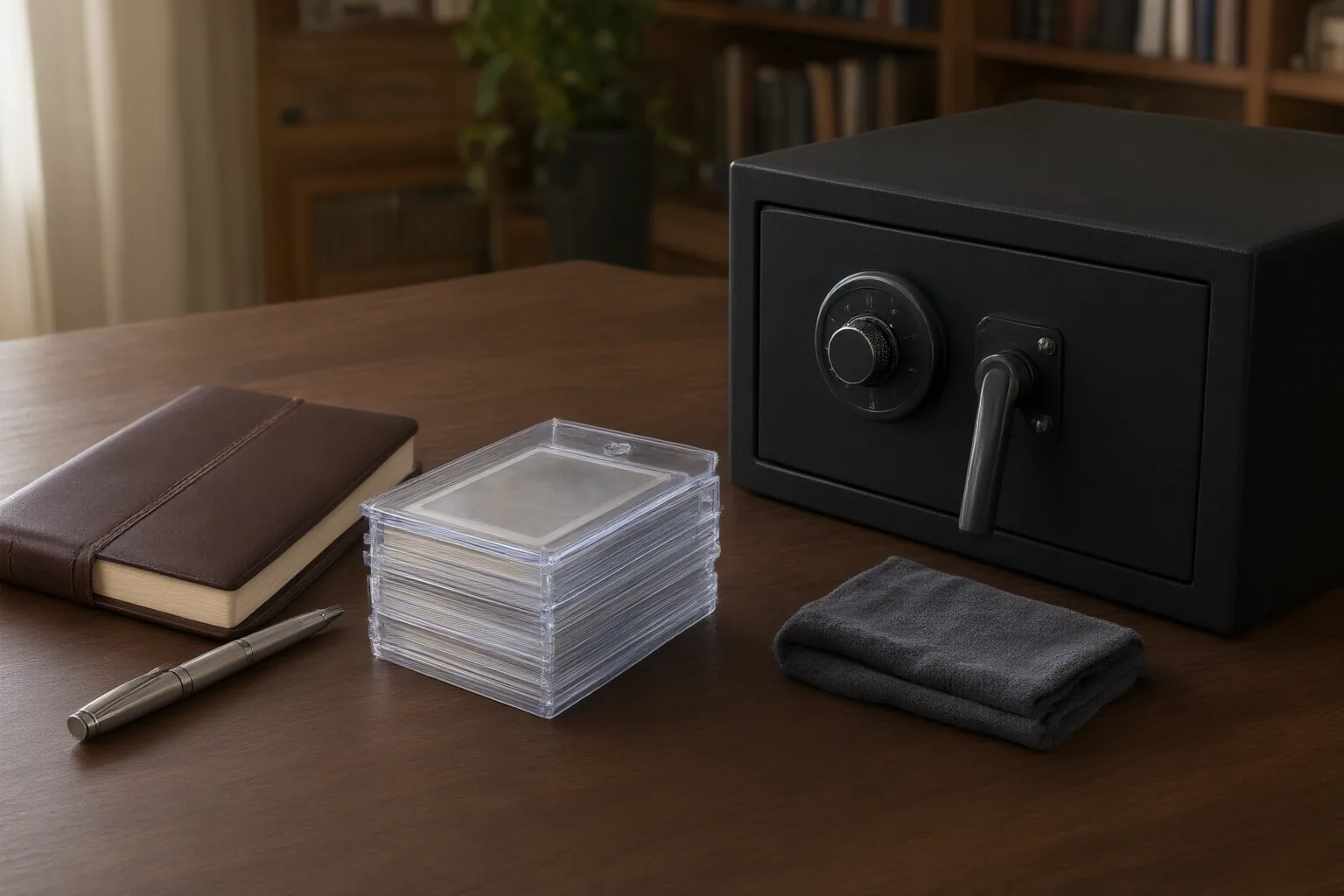
An emergency recovery record should bring together a documented collection inventory, relevant insurance information, recovery contacts, and clear instructions for finding protected copies. This is a practical application of general emergency and backup guidance, not an official trading-card standard.
The essential information to record
Start with a property inventory that identifies the trading cards or groups of cards covered by the record. The source guidance does not prescribe collection-specific fields, so decide what level of description will make your inventory understandable without presenting that choice as an official requirement.
Add the recovery information connected to that inventory:
- Relevant insurance policies.
- The name and contact details of the appropriate insurance agent.
- Contact details for service providers that may be needed during recovery.
Ready.gov recommends gathering critical information and documenting property before a disaster. It also identifies insurance policies, insurance-agent information, and service-provider contacts as useful recovery records. Combining those elements into one collection-focused record is an editorial adaptation of that general guidance; neither cited source establishes a special standard for trading cards.
Review the record for gaps that could slow your response. An inventory without its related contacts may leave you searching for separate documents, while contact details without a usable property record may provide little context. Keep the information organised so each part can be understood alongside the others.

Where to keep accessible, protected copies
A recovery record must be protected, but it also needs to remain available if its usual location cannot be reached. Ready.gov suggests safeguarding important documents in a safe-deposit box, on an external drive, or in cloud storage. These are general options rather than a direction to use any particular provider or method.
Choose storage arrangements that do not depend entirely on the place where the collection and primary record are kept. Record which copy is treated as the main version and where protected alternatives can be found. Accessibility should not mean broad distribution: the same guidance warns against unnecessary sharing of personal financial information.
Because insurance and contact records may contain sensitive details, limit what you duplicate to information needed for recovery and control who can reach it. The appropriate balance depends on the collector’s circumstances. The central aim is to avoid two opposite failures: a record lost with the collection, or sensitive information exposed simply to make access convenient.

How to make the record recoverable
A stored copy is only useful if its location and retrieval process are understood. As a cautious adaptation of general backup-planning guidance, document:
- What parts of the inventory, insurance record, and contact list are copied.
- Where each copy is stored.
- How long each copy is retained.
- How the information can be restored or retrieved.
- Who owns any relevant account and who is responsible for access.
Eappsi recommends defining backup coverage, storage location, retention, restoration arrangements, account ownership, and access responsibilities. That source addresses general backup planning rather than trading-card collections, but its questions provide a useful structure for collection record keeping.
Check that the instructions make sense when the primary copy is unavailable. A note that information is “backed up” gives limited reassurance if it does not identify the location, responsible person, or retrieval route. Update the access notes when an account owner, storage location, retention choice, or responsibility changes. This keeps the recovery instructions aligned with the copies they describe without implying that any particular review schedule is officially required.
Conclusion
Build the record in three layers: a documented collection inventory, the insurance and service-provider information relevant to recovery, and a map of the protected copies. For every copy, state what it contains, where it is kept, how it can be retrieved or restored, and who controls access.
These steps combine Ready.gov’s advice on property documentation and safeguarded records with general backup-planning principles from Eappsi. They are a practical editorial framework, not collection-specific rules issued by either source.
Create or review your emergency recovery record now. Then use its instructions to verify that a protected backup can be accessed and restored when the primary copy is unavailable, while keeping sensitive financial information from being shared unnecessarily.
Disclosures and limitations
- This article was prepared with AI assistance from the supplied Ready.gov and Eappsi research summaries; its collection-specific checklist is an editorial application of their general guidance.
- No products are recommended and no affiliate relationship is presented. Readers should verify arrangements against their own storage, access, and insurance circumstances.
Related reading
Sources
- WordPress Website Maintenance Services | Eappsi — eAppsi – Welcome to Eappsi – Your Premier Web Design Service Provider
- Financial Preparedness — ready.gov