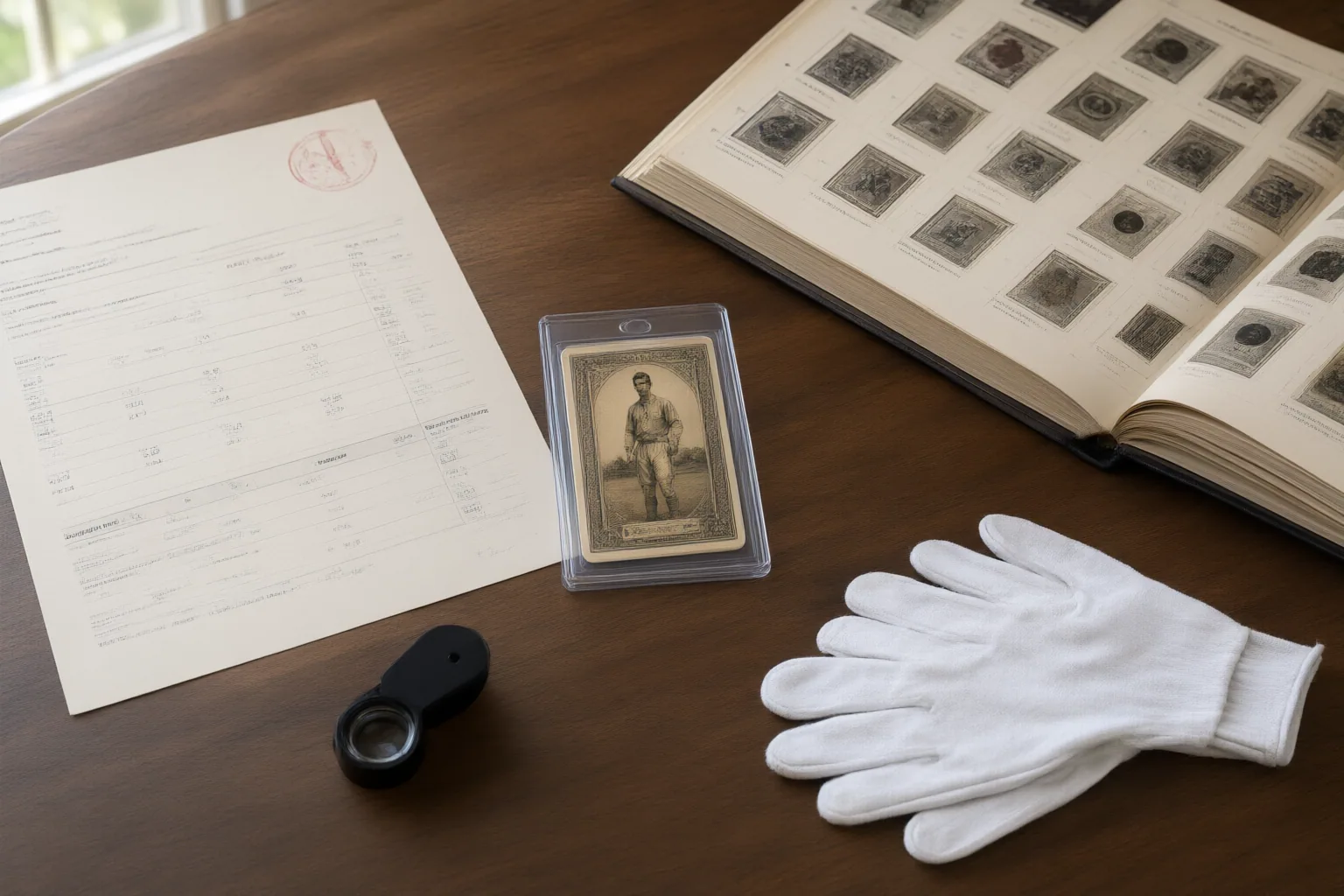
An auction invoice can support a card’s provenance, but it should be checked against the original catalogue or past-auction lot. Compare the records with the offered card, investigate missing links and request further documentation before relying on the invoice.
What an auction invoice can—and cannot—show
An auction invoice and an auction catalogue serve different purposes. Antiqon says a winning bidder’s invoice details the hammer price, buyer’s premium and applicable charges. By contrast, an individual catalogue lot may include photographs, a description, attribution, estimated values and available condition information.
This distinction matters when an invoice is offered as evidence of collectible card provenance. The financial record can show that a transaction occurred, but the supplied research does not establish that an invoice alone proves the card now being offered was the item in that transaction. The connection must be assessed using the associated lot materials.
Treat the invoice as one part of the evidence chain. Its value depends on whether it can be linked to the original auction lot and whether that lot’s photographs and written information correspond to the offered card. This comparison supports a provenance assessment; it is not a remote authentication method.
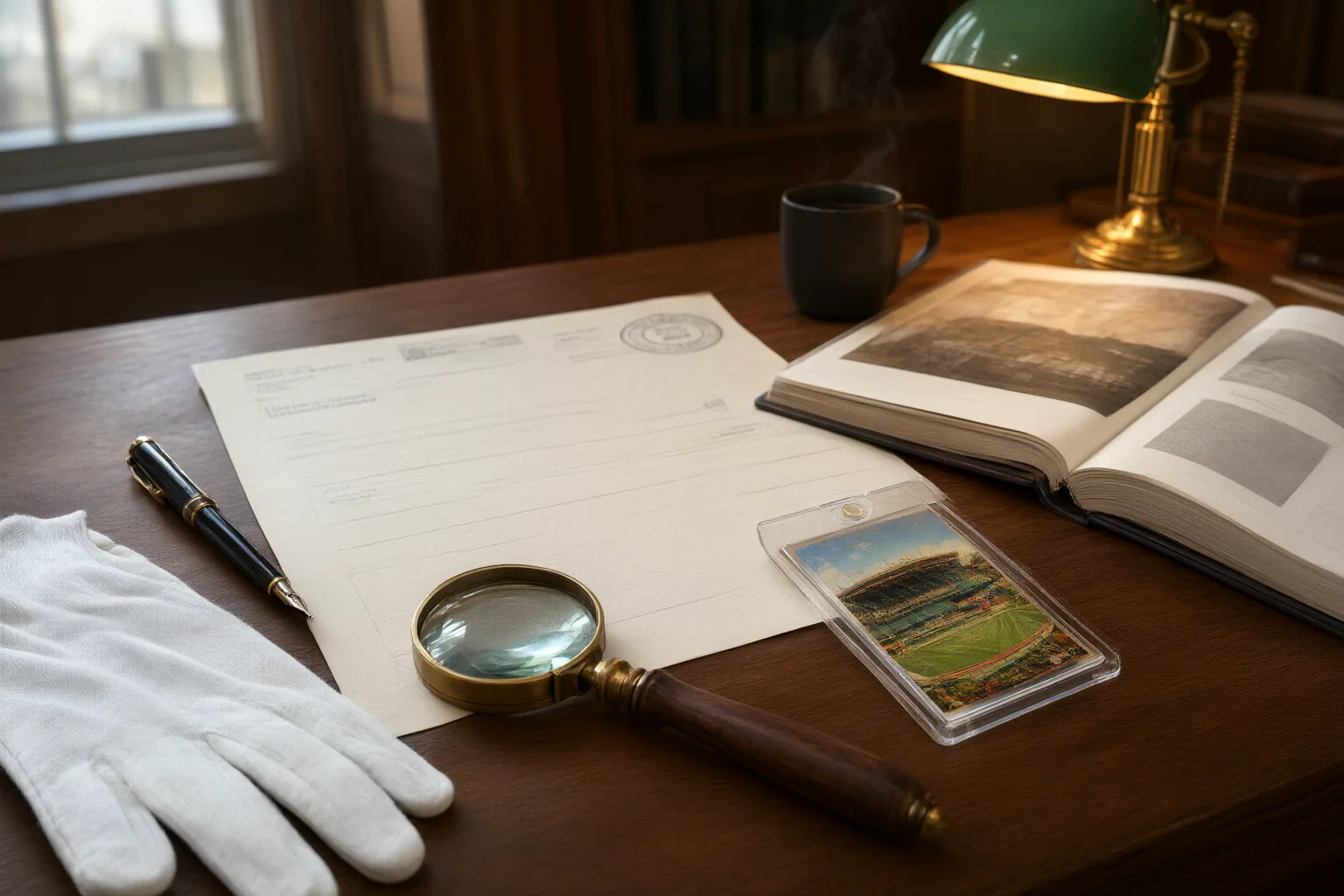
Find the original catalogue and past-auction lot
Start by locating the auction house’s catalogue or archived lot record rather than relying only on an invoice or payment page. Archives International presents separate navigation options for searching past auctions and paying an invoice. This shows why the records may need to be retrieved through different parts of an auction website.
Antiqon states that upcoming catalogues are usually available 30–60 days before a sale, but the practical question after a sale is whether the corresponding catalogue or archived record remains accessible. Search the available past-auction function for the underlying lot and collect the materials attached to it.
Useful catalogue evidence includes the lot photographs, description, attribution, provenance and available condition information. Antiqon recommends reviewing those materials and requesting further documentation when necessary. If the past-auction search does not produce a sufficiently detailed lot record, ask the relevant party for the original catalogue entry or other documentation connecting the invoice to that lot. Do not assume that an invoice-payment page contains the descriptive evidence found in the catalogue.
Compare the invoice, lot record and offered card
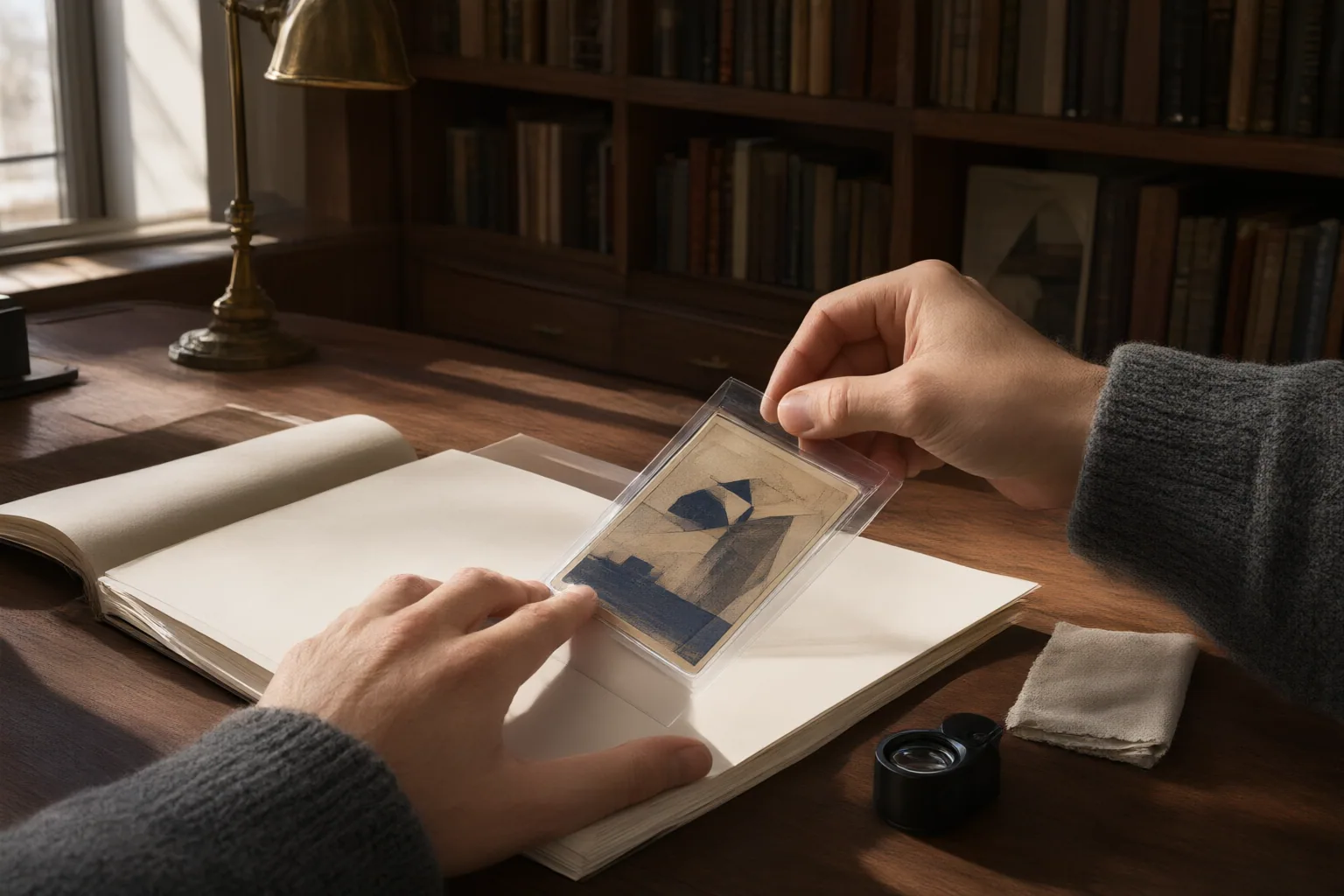
Use a three-part comparison: the invoice, the original lot record and the card currently being offered.
- Connect the invoice to the lot. Determine whether the information supplied with the invoice clearly identifies the catalogue entry or past-auction record being claimed. If that connection cannot be established from the available documents, request supporting material rather than filling the gap by assumption.
- Read the full lot description. Compare the offered card with the catalogue’s description, attribution and provenance statements. Record what agrees, what conflicts and what the surviving materials do not address.
- Examine the catalogue photographs. Compare the offered item with the pictured lot using only details that are actually visible. The research does not supply a card-specific example or establish that photographs alone can authenticate a card, so a visual resemblance should not be treated as definitive proof.
- Review condition information. Check the available condition material alongside the photographs and description. A difference may require explanation, but the supplied sources do not provide a rule for deciding why a card’s condition appears different.
- Resolve missing evidence. Antiqon recommends requesting further documentation where necessary. If photographs, provenance statements, descriptions or condition information are absent, the invoice has less contextual support for connecting the offered card to the original lot. Ask for the missing lot materials before deciding how much evidential weight to give it.
This workflow tests whether the documents form a coherent chain. It does not provide remote authentication or guarantee the identity of the card.
Conclusion
An invoice and an original auction lot record are complementary evidence. The invoice documents financial elements of the sale, while the catalogue may preserve photographs, descriptions, attribution, provenance and condition information. Neither should be evaluated in isolation when the question is whether a particular collectible card came from that lot.
Retrieve the original lot record, compare it with both the invoice and the offered card, and seek further documentation for every unresolved connection. Before relying on the claimed provenance, save copies of the invoice and available lot materials together with notes identifying any discrepancy or missing evidence.
Disclosures and limitations
- This article was prepared with AI assistance from the supplied auction-process sources and does not remotely authenticate any collectible card. It contains no product recommendation or disclosed affiliate promotion.
Related reading
- Provenance & Ethics
- How to Investigate Gaps in a Collectible Card’s Chain of Custody Before Buying
Sources
- Archives International LLC — Archives International LLC
- Upcoming Auctions of Fine Art & Antiques — Antiqon