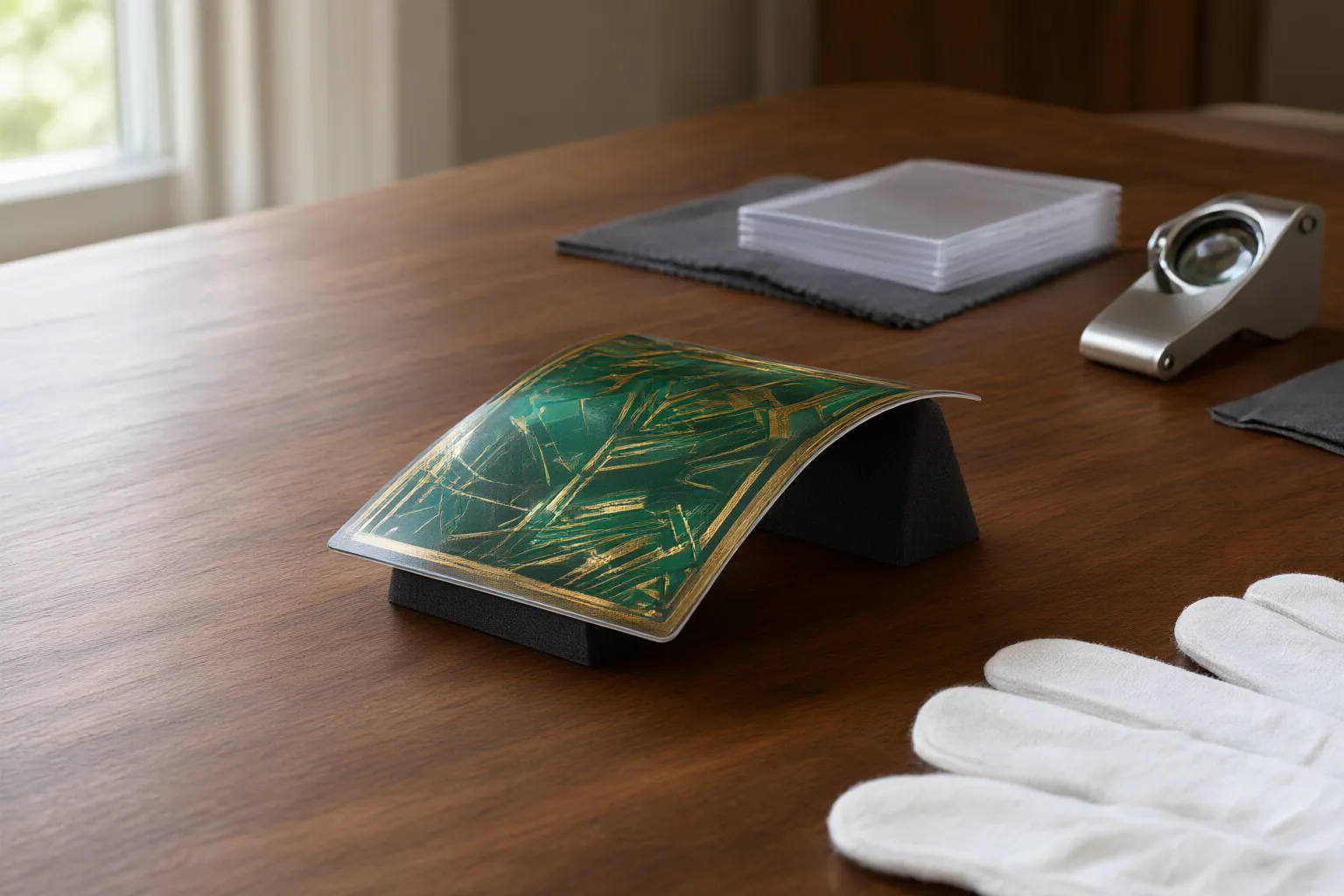
Assess card warping before submission by viewing the card at eye level from every side. A smooth, symmetrical arc may differ from structural deformation marked by uneven lift, twisting, creasing, separation or surface stress. Curvature should then be considered alongside the card’s full condition and the grading company’s current official standards.
Start with a four-sided profile inspection
Place the card on a clean, flat surface, without pressing it down, and lower your viewpoint until its profile is at eye level. Examine all four sides in turn. This method can reveal height differences that are difficult to see when looking straight at the card’s face.
Record what you observe rather than deciding immediately whether the card is suitable for grading. Note whether both long edges rise evenly, whether one corner lifts more than the others, and whether the card appears to twist diagonally. Turning the viewing position around the card is important because a head-on inspection can conceal an uneven bend or corner lift.
Use suitable lighting to inspect the visible profile, but avoid treating this check as authentication or a grade prediction. Its purpose is narrower: to establish whether the curvature appears consistent across the card or whether its shape changes from one side to another.
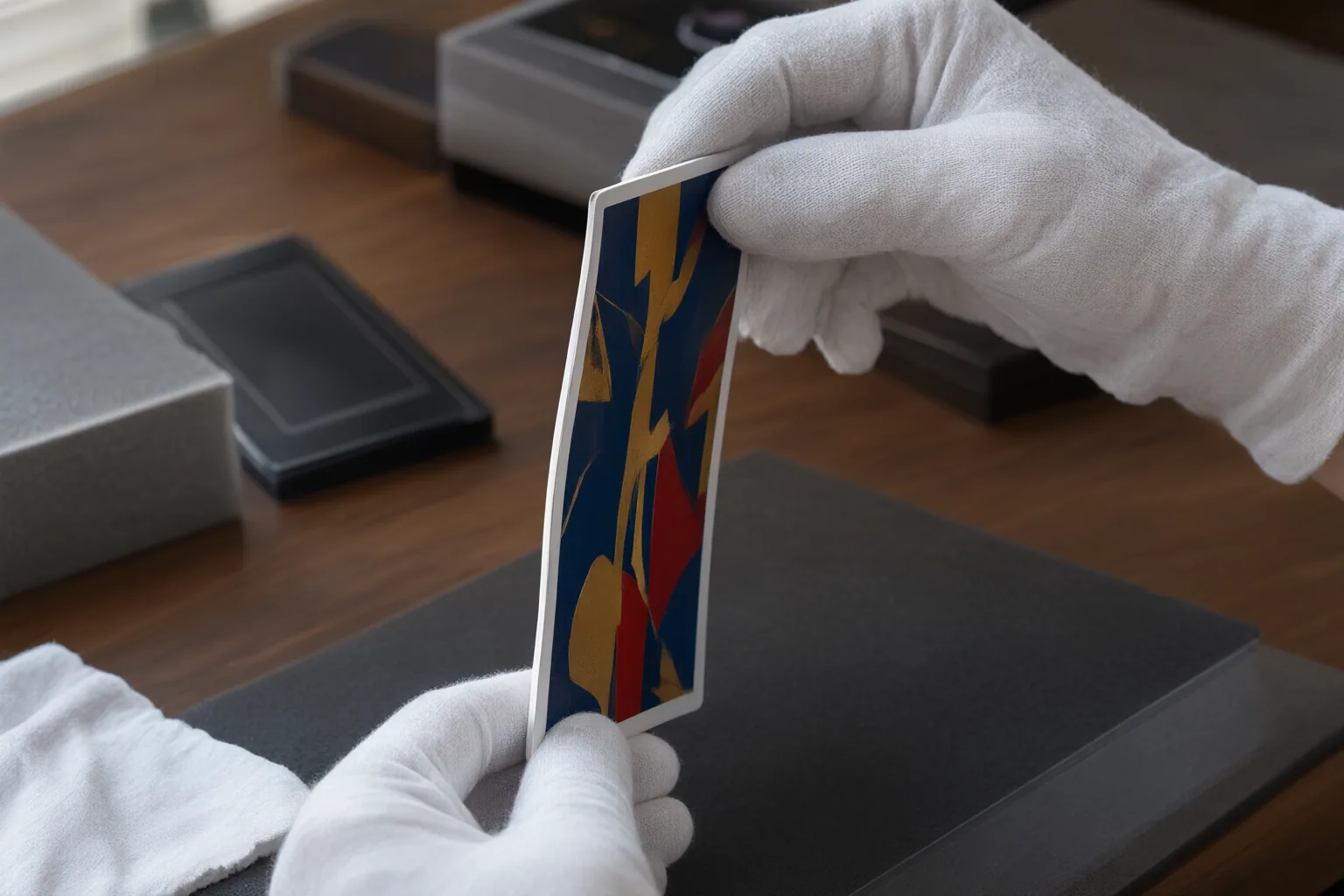
Distinguish uniform foil curl from uneven warping
The cited practical guide describes mild foil curl as a smooth, symmetrical arch. It explains that paper cardstock and a laminated metallic foil layer may respond differently to ambient humidity, producing uniform curvature. This offers a possible explanation for an evenly arched foil card, but it does not prove the cause in any individual case or determine how a grading company will evaluate it.
By contrast, the guide describes structural warp as an asymmetrical bend, uneven corner lift or diagonal twist. Compare the card’s opposing edges and corners: a consistent arc across its width is visually different from one corner rising alone or the card changing direction along its length.
Do not assume that every foil card with curvature has structural damage, or that a uniform curve is harmless. The supplied material does not establish universal rules for grade outcomes or reversibility. Treat the shape as one observation, document it accurately and look for accompanying damage before making a submission decision.
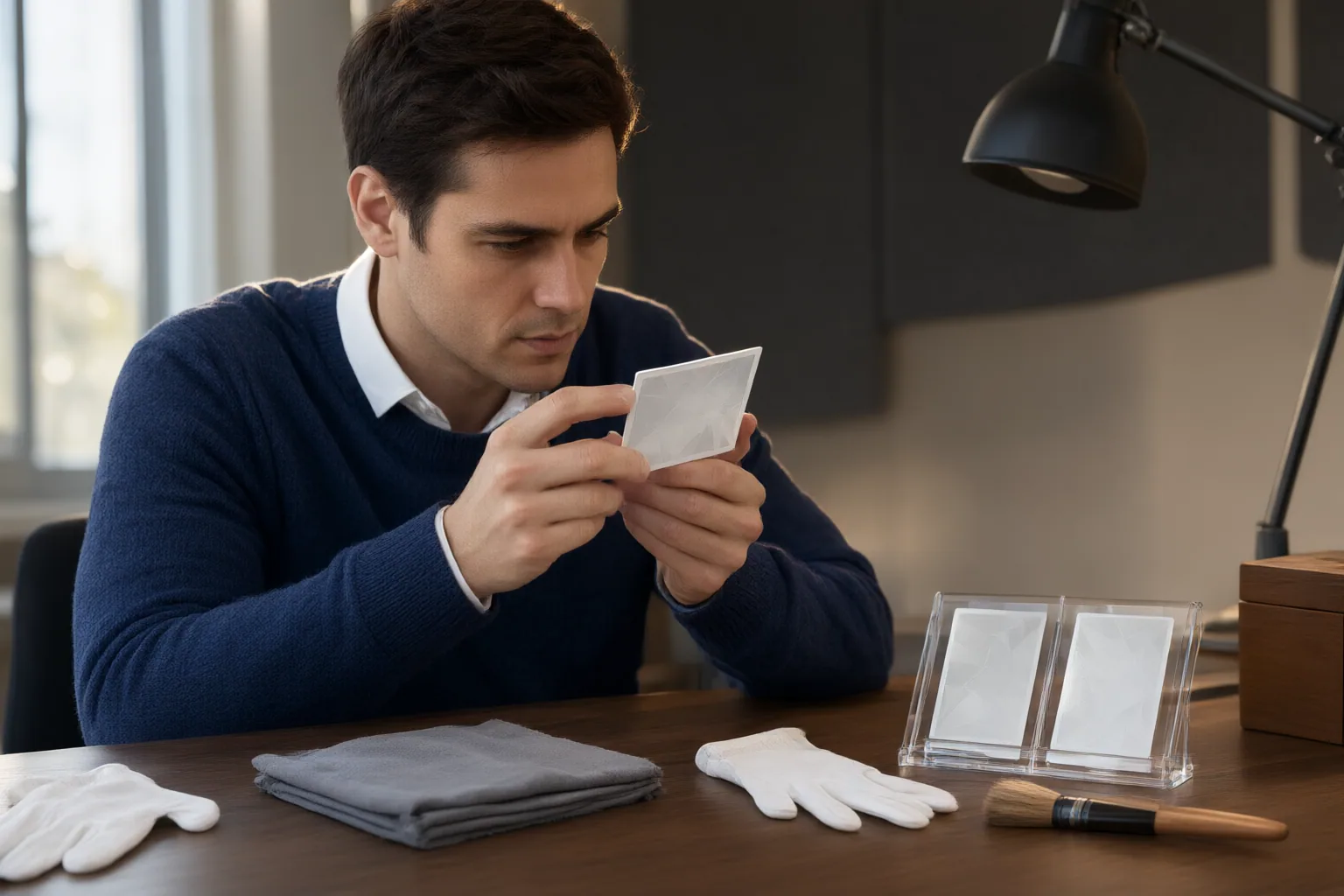
Check for damage and review the whole card
Look closely for creasing, paper-layer separation and surface stress, which the cited warping guide identifies as signs of damage. It associates uneven structural warping with possible physical trauma, uneven pressure, extreme heat or improper binder storage. These are possible associations, not a reliable way to reconstruct a particular card’s history.
Avoid direct heat and irons. The same guide warns against those approaches and says attempts to correct structural warping may risk creases or internal fibre damage. The supplied sources do not support presenting any flattening treatment as universally safe or guaranteed to improve a grading result.
Curvature is only one part of card condition. Inspect front and back centering, corner sharpness, edge whitening, surface scratches, print lines, staining and discolouration. Corners, edges, surface and centering are presented as core grading categories in the submission guidance. Record each issue separately so an apparently modest curve does not distract from other defects, and an uneven profile is not dismissed because the face otherwise looks clean.
For the final submission decision, consult the selected grading company’s current official documentation. Both sources used here are third-party guidance, so neither should be treated as a grading company’s binding policy.
Conclusion
A useful inspection separates observation from prediction. First determine whether the curve looks smooth and symmetrical or uneven and twisted. Then check for creasing, separation or surface stress and review centering, corners, edges and the entire surface. These steps can organise a condition assessment, but they cannot promise a grade or establish the cause of a card’s shape.
Before submitting, place the card on a clean, flat surface, inspect its profile from all four sides and record any uneven lift, twist, crease, separation or surface stress. Compare that written condition record with the chosen grading company’s current official standards.
Disclosures and limitations
- This article was prepared with AI assistance from the supplied third-party research sources. Those sources are not official grading-company documentation; consult the selected grader’s current official standards before submission.
- No products are recommended and no affiliate relationship is represented in this article.
Related reading
Sources
- TAG Card Grading Guide: Complete Submission Process — Graders Choice
- Is Your Card Curved or Warped? Card Grading & Foil Curling Guide — DEDCcard