
An altered or trimmed designation generally separates authenticity from condition: the cited guidance reports that a card may be considered genuine yet receive no numerical grade because an alteration is present. The exact wording matters, but it may not reveal the specific alteration, so check the certification record and the grading company’s current published terminology before drawing conclusions.
What an altered or trimmed designation tells you
The supplied guides report that PSA’s “Authentic” designation confirms genuineness without assigning a numerical condition grade. According to those sources, this outcome may reflect an alteration, a major defect, or a submitter’s request for authentication without grading. It therefore should not be read as a numbered assessment of the card’s condition or as confirmation that the card is unaltered.
“Authentic Altered” is more specific in one respect: the reported meaning is that the card is considered genuine but cannot receive a numerical grade because an alteration is present. Even then, broad wording may not identify what was changed. The sources list trimming, recolouring, restoration and cleaning as examples, but collectors should not infer which one applies unless the label, certification record or other documentation says so.
Because the available material is secondary reporting rather than current official documentation, confirm the named grading company’s present definitions and policies.
Trimming, other alterations and factory miscuts
The sources define trimming as the removal of material from one or more edges after manufacture. It may be done to reduce visible wear or make edges and corners appear sharper. An altered designation can also reflect a different intervention, however, including reported examples such as recolouring, restoration or cleaning. A general “Authentic Altered” label alone does not establish that trimming was the issue.
Trimming is also distinct from a factory miscut. The cited guidance describes a miscut as a manufacturing defect, while trimming is a later alteration. An unusual outline, uneven border or off-centre appearance should therefore not be treated on its own as proof that material was deliberately removed. Manufacturing irregularities can resemble some signs collectors associate with trimming.
Label practices may vary over time. One source reports that older PSA holders could name an alteration with wording such as “Authentic – Trimmed,” whereas later labels may use the broader “Authentic” or “Authentic Altered” wording without identifying a particular type.
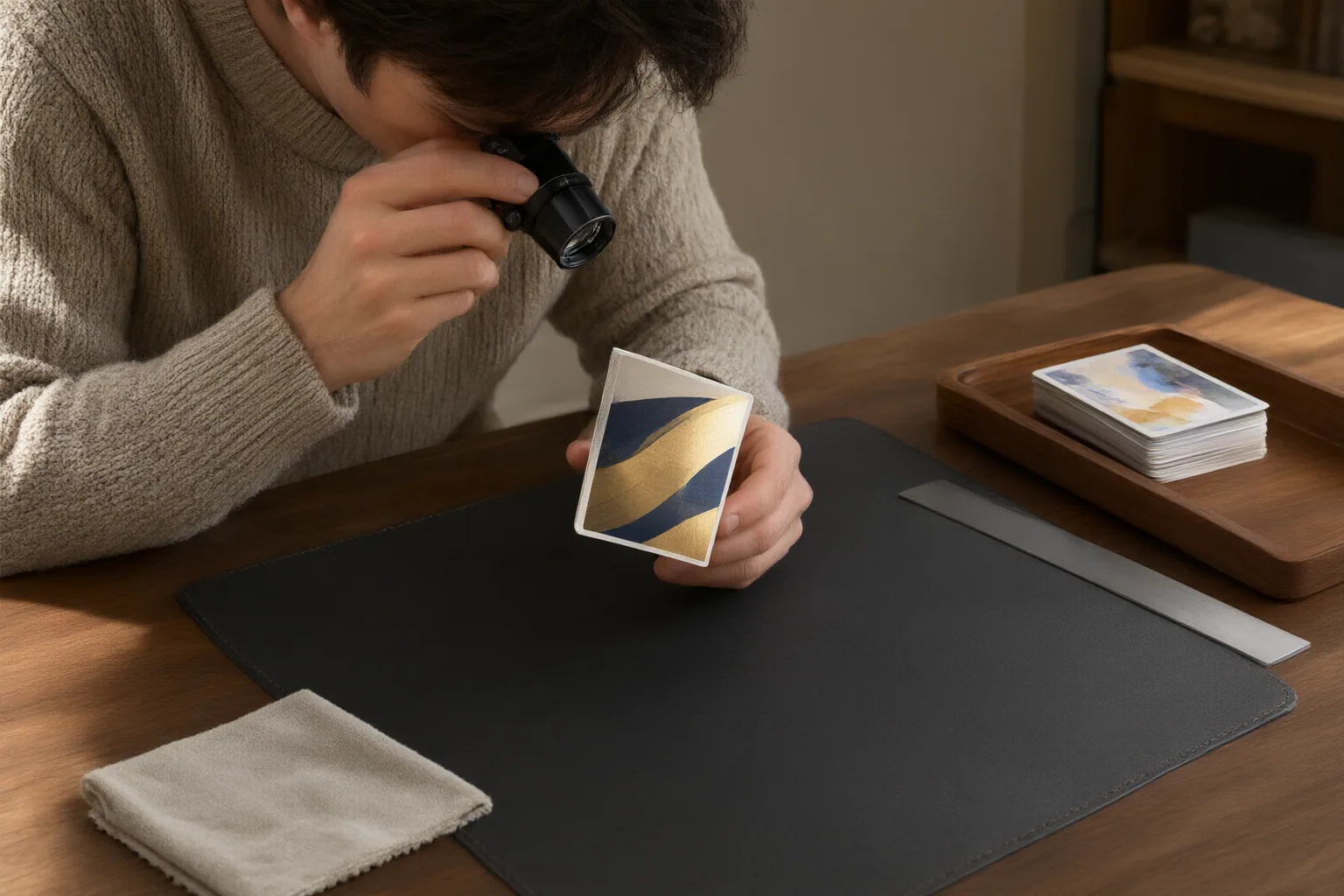
How to inspect a card without overreaching
Inspection can help identify reasons for further scrutiny, but it cannot conclusively determine authenticity or explain a grading company’s decision. The supplied guides discuss checking dimensions, viewing edges under magnification and angled light, and examining edge texture and corner shape. These methods may reveal differences, yet subtle alterations can remain difficult to detect.
Comparison is more useful when the reference is reliable. Place the card against known-authentic examples from the same set or era and look for differences in dimensions, edge fibres, texture and corner formation. Use more than one method rather than relying on a single measurement or visual feature. A small dimensional difference is not automatically proof of alteration, particularly when factory cutting irregularities are possible.
Keep the conclusion proportionate to the evidence. A suspicious edge can justify closer examination, a request for documentation or consultation of the certification record, but the cited screening methods do not establish remotely that a card was trimmed or identify why a particular designation was assigned.
Conclusion
Authenticity, alteration status and numerical condition are separate questions. Under the terminology reported by the supplied sources, “Authentic” is not a numerical grade, while “Authentic Altered” indicates a genuine card that was not numerically graded because an alteration is present. Neither broad designation necessarily identifies the card’s precise condition or, without further information, the specific alteration.
Wording on older and later holders may differ, and the secondary sources supplied here may not reflect every current policy. Before buying or recording the card, verify its certification record, consult the grading company’s current published standards, and request any available submission details or clarification. Then compare the card with reliable, known-authentic examples from the same set and document what can—and cannot—be concluded from the label and physical inspection.
Disclosures and limitations
- This article was prepared with AI assistance from the supplied collector guides and secondary reporting; current terminology and policies should be verified against the grading company’s official documentation.
- No products are recommended and no affiliate relationship is represented in this article.
Related reading
Sources
- How To Spot a Trimmed Card — All Vintage Cards
- How to Spot Trimmed and Altered Sports Cards (Complete Guide 2026) — AgentGrail
- How To Spot Trimmed, Recoloured, Or Altered Pokémon Cards Before You Buy – GrandCollector — GrandCollector
- What Does ‘Authentic’ Mean In Card Grading? — All Vintage Cards