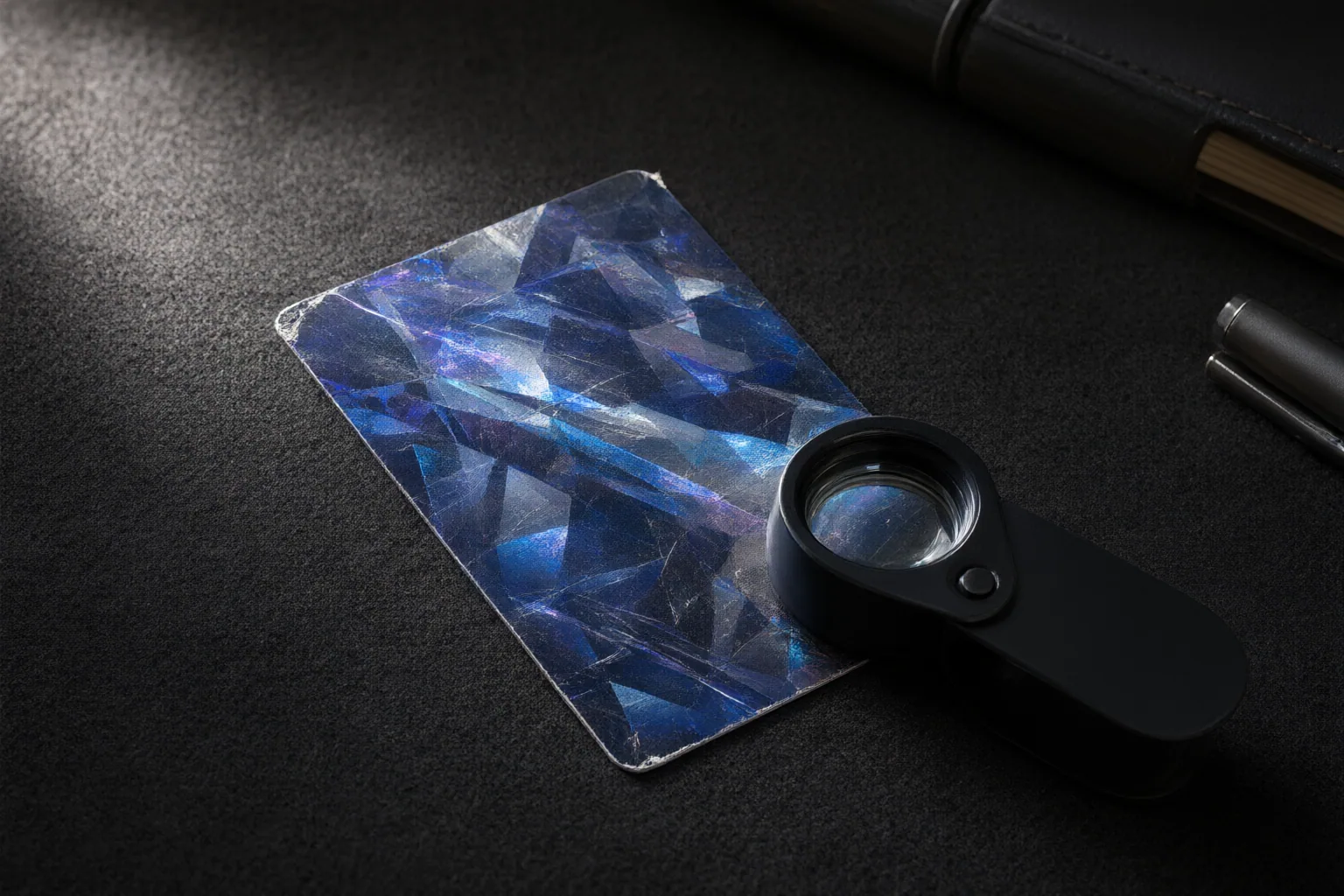
Card surface flaws can be easy to miss yet still limit a grading outcome. Inspect both sides under moving angled light, use magnification for closer checks, and treat any home grade estimate as provisional rather than a prediction of the final professional decision.
Why surface flaws matter in card grading
Surface condition is one part of a broader card inspection that also considers corners, edges and centering. A card can therefore have sharp-looking corners while scratches, print lines, dents, pits or other surface defects constrain its overall condition.
Possible issues also include fingerprints, residue, clouding and changes in gloss. Some are immediately visible, but others appear only when illumination crosses the surface at a revealing angle. Looking exclusively at the card face-on or under ordinary overhead light can create an incomplete impression.
The practical lesson is to assess the surface independently instead of allowing one strong feature to determine expectations for the whole card. The supplied collector guides do not establish universal tolerances or grade limits for individual defects, so the presence of a mark should be documented without assigning it a guaranteed grading consequence.
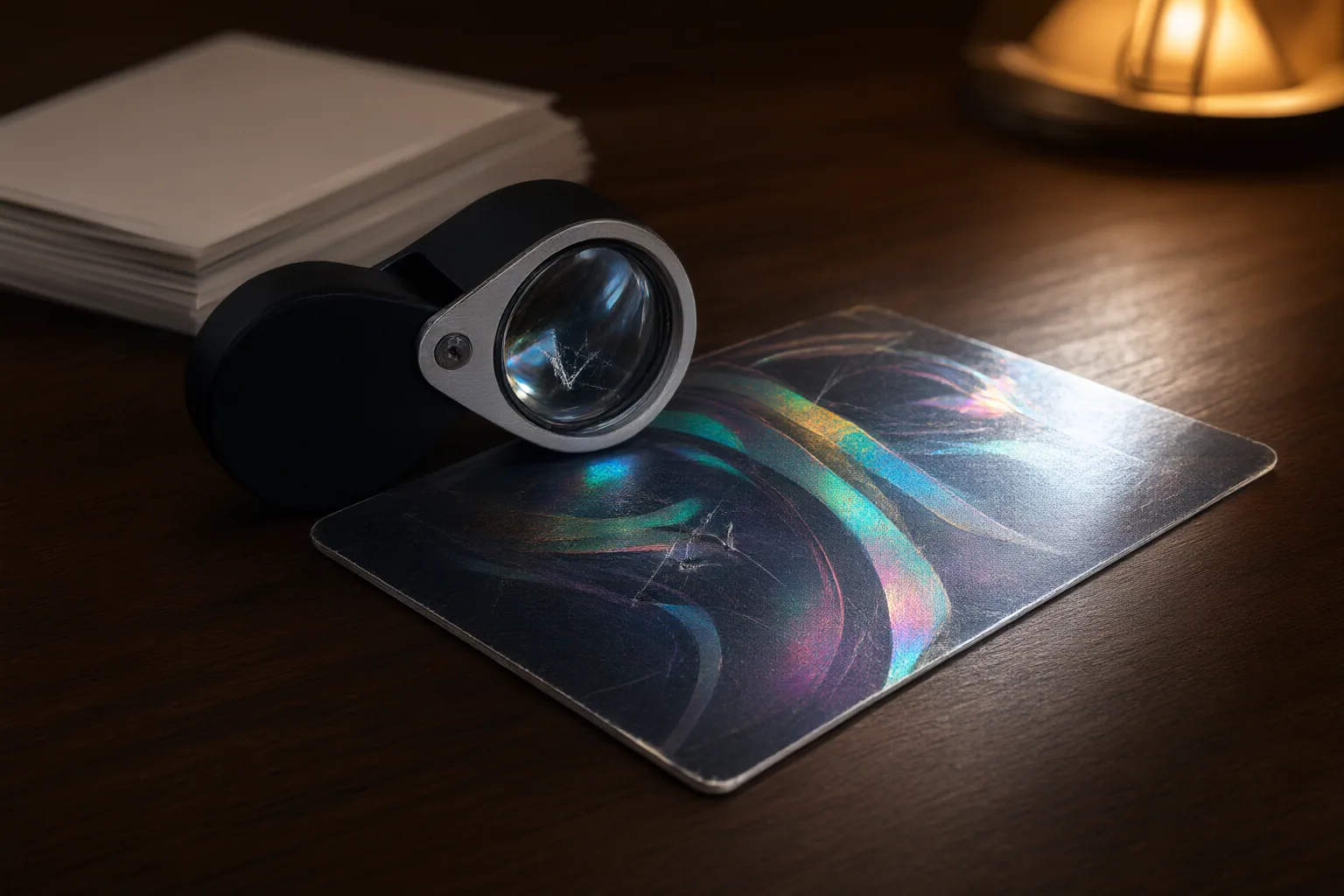
How to inspect a card surface
Begin with bright illumination and examine both sides rather than concentrating only on the front. Hold the card so the light reaches it from an angle, then tilt it slowly. Changing the viewing angle can reveal fine scratches, print lines, roller-like marks, dents and finish disruptions that remain difficult to see in a fixed, straight-on view.
Repeat the movement instead of relying on a single angle. Watch how reflections travel across different areas, including the image, borders and otherwise uniform sections. Reflective, chrome, foil and glossy finishes deserve particular care because scratches, fingerprints and disruptions in the finish may become clearer as the reflected light moves.
Use magnification as a secondary aid after the broader angled-light review. It can help with subtle marks and closer checks of the surface, corners and edges, but it does not turn a home inspection into a guaranteed pre-grade.
For a useful record, note each mark’s location, apparent type and visibility. For example, record whether it appears under several angles or only under one lighting position. This creates a more disciplined condition summary while preserving the essential limitation: finding and describing potential flaws is not the same as predicting how a professional grader will weigh them.

Print lines, scratches and grading uncertainty
Print lines are described in the supplied guides as manufacturing-related marks, whereas scratches are associated with handling or contact. Their appearance may offer clues: a print line may follow a straighter, more regular path, while a scratch may run in a less regular direction. These are limited visual indicators, not a reliable way to establish origin in every case.
That distinction also should not be treated as an automatic grading exemption. The sources agree that a factory-origin mark can still matter, but they do not support one universal rule for every print line, card or grading company. Claims about exact deductions, grade caps or tolerances would therefore go beyond the available evidence.
Severity and visibility add further uncertainty. A home inspection can identify potential concerns and help a collector form more realistic expectations, but it cannot determine exactly how those concerns will be evaluated in a final professional decision. Record what is visible and avoid converting an appearance-based judgment into certainty about either a mark’s cause or the resulting grade.
Conclusion
Careful surface inspection can expose issues that a casual look misses, but it remains a screening and record-keeping exercise rather than a grade guarantee. Examine both sides under moving angled light, use magnification for subtle areas, and note every flaw’s location, type and visibility. Before deciding whether to submit the card, keep any estimated grade provisional until a professional grading decision is made.
Disclosures and limitations
- This article was prepared with AI assistance from the supplied research package and was limited to facts attributed to its listed collector-guide sources.
- The cited materials are commercial collector guides, not official grading-company standards; no company-specific tolerance, grade cap or outcome is implied. No products or affiliate recommendations are included.
Related reading
Sources
- Surface Defects That Kill Your Card's Grade: The Comp… | PreGradeCards — PreGradeCards
- Card Condition: The Complete Guide to Grading, Inspection, and Value — Midpoint – Card Centering, Grading, Portoflio Manangement Blog
- 10 Common Card Grading Mistakes (And How to Avoid Them) | CardGrade — cardgrade.io
- How to Grade Trading Cards at Home: The Complete 2026 Guide | GradingMetric — GradingMetric
- Card Defects Complete Visual Guide | PreGradeCards — PreGradeCards
- Grading Card Surface vs Corners: The Ultimate Comparison Guide — Midpoint – Card Centering, Grading, Portoflio Manangement Blog